Ban Gerrymandering Toolkit | Take Action | Redistricting Loteria
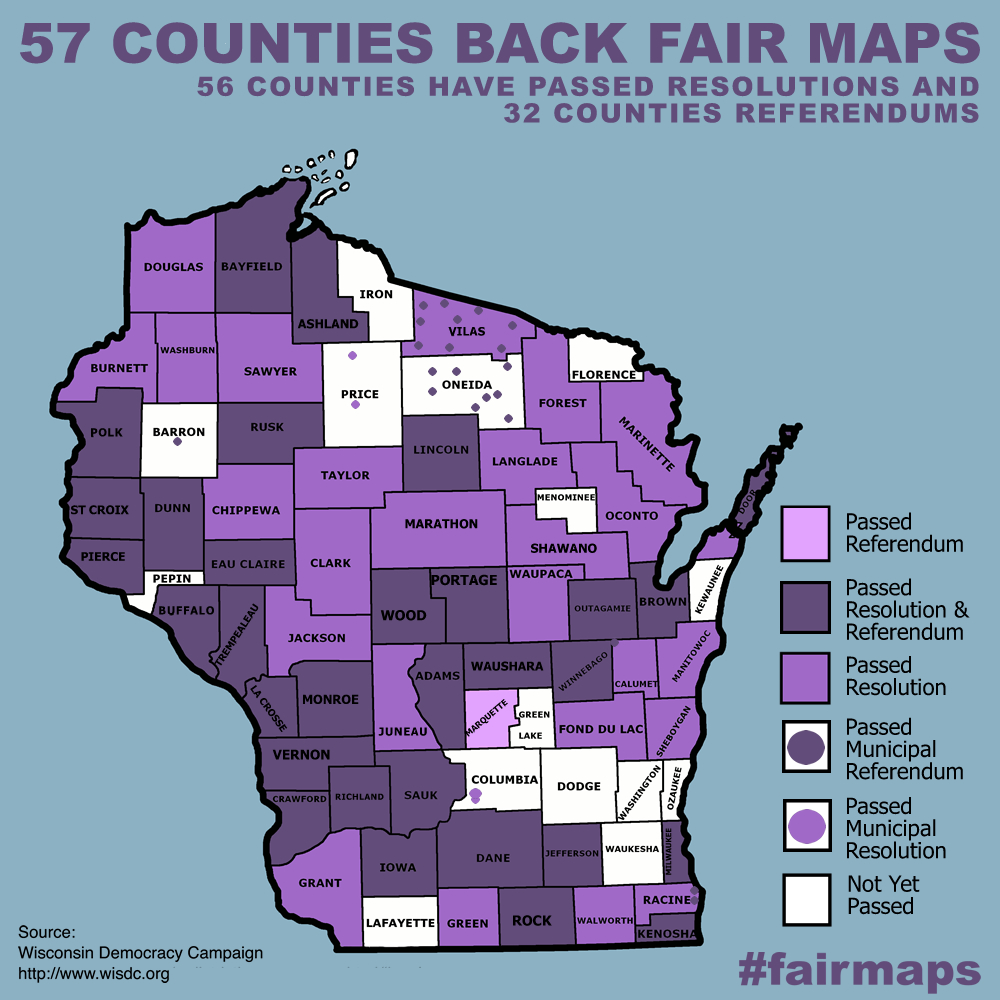
Every 10 years, after the national Census is taken, states redraw the boundaries for their legislative and congressional districts.
In Wisconsin, the State Legislature has constitutional authority when it comes to apportionment and redistricting. The political party that’s in power at the time – whether Democratic or Republican – has tended to draw maps that are tailor-made for their reelection. If neither party has full control, sometimes a deal can be made, and if not, a judge will intervene and impose a map, as has happened three times in the last forty years.
The Rigging of the Maps in 2011
In 2011, the GOP in Wisconsin swept to power, taking over control of the Assembly, the Senate, and the Governor’s office, and it took the practice of partisan map rigging to new levels.
It also decided to redraw the maps not in public, in the Wisconsin Capitol, but instead in a locked office of the private, pricey law firm across the street, Michael Best & Friedrich.
The media wasn’t allowed in. The public wasn’t allowed in. Democrats weren’t allowed in. Even Republican legislators who were not in leadership had to ask to be let in the locked room, and once they got to see their own redrawn districts, they had to sign an oath of secrecy.
That’s not how the people’s business is supposed to be done.
The Republican leadership hired demographic specialists and computer experts to employ the latest mapping technology to create maps that were more rigged than almost any in modern history.
The leadership then rammed the maps through the legislature in ten days flat. The bill, 2011 Act 43, was then signed into law by Gov. Scott Walker.
And the new maps did what they were designed to do: They ensured that the Republicans grabbed more seats. For instance, in the first election under the plan, Republicans won 60 out of 99 seats in the Assembly despite losing the aggregate statewide vote.
2011 Maps Legal Challenges
The first legal challenge was Baldus v. Brennan. A panel of three judges declared two Assembly districts in Milwaukee to be an unconstitutional violation of the federal Voting Rights Act. After the Legislature and plaintiff could not agree on an amended map, the judges selected maps drawn by the plaintiff, the immigrant rights group Voces de la Frontera, over two maps presented by the state Legislature. This resulted in Assembly District 8 becoming a majority-minority district.
Subsequently, a group of Democratic voters sued the state of Wisconsin in federal court in the so-called Whitford case, claiming that their rights had been violated and their voices silenced.
On November 21, 2016, a separate panel of federal judges agreed and tossed the redistricting maps.
By a vote of 2-1, the judges sided with the plaintiffs. In a landmark ruling, they said these maps violated the First and Fourteenth Amendment rights of the Democrats who sued.
“It is clear that the drafters got what they intended to get,” concluded federal judges Barbara Crabb and Kenneth Ripple. (Crabb was appointed by President Carter, and Ripple was appointed by President Reagan.) “There is no question that Act 43 was designed to make it more difficult for Democrats, compared to Republicans, to translate their votes into seats. . . . It secured for Republicans a lasting Assembly majority. It did so by allocating votes among the newly created districts in such a way that, in any likely electoral scenario, the number of Republican seats would not drop below 50%.”
Wisconsin’s Attorney General Brad Schimel appealed the case to the U.S. Supreme Court, and the Republican leaders in the legislature also hired expensive lawyers to argue their side. The citizens of Wisconsin have been footing the bill to defend these rigged maps.
The U.S. Supreme Court’s Decisions
On June 18, 2018, the U.S. Supreme Court essentially punted in its decision in Gill vs. Whitford. It said that the plaintiffs failed to demonstrate individual harm in their particular districts and therefore did not have sufficient “standing” to bring their case. But rather than throw it out, the Supreme Court sent it back to the trial level for more fact-finding and additional testimony. And, Justice Elena Kagan offered the plaintiffs a new line of argument: that the rigged maps interfered with the plaintiffs’ First Amendment right of association, and that this interference does not have to be proven district by district. Every member of whichever party is being disadvantaged by the gerrymander suffers from the violation of this right, she said: “Members of the ‘disfavored party’ in the State, deprived of their natural political strength by a partisan gerrymander, may face difficulties fundraising, registering voters, attracting volunteers, generating support from independents, and recruiting candidates to run for office (not to mention eventually accomplishing their policy objectives).”
The lawyers on the Whitford side, in their amended complaint to the lower court, added Kagan’s argument almost word for word, and also added more plaintiffs who could demonstrate individual harm in their own districts. Three federal judges were expected to hear the case again in Madison in July. But on June 27, the U.S. Supreme Court, in a sweeping ruling, rejected the arguments in the North Carolina and Maryland cases that partisan gerrymandering should be remedied by the courts.
“We conclude that partisan gerrymandering claims present political questions beyond the reach of the federal courts," Chief Justice John Roberts wrote. "Federal judges have no license to reallocate political power between the two major political parties, with no plausible grant of authority in the Constitution, and no legal standards to limit and direct their decisions." This, even though Chief Justice Roberts acknowledged that partisan gerrymandering was “incompatible with democratic principles.”
Justice Elena Kagan, writing for the four liberals on the court, dissented bluntly. Gerrymandering, she said, is “anti-democratic in the most profound sense," and the types of partisan gerrymandering presented to the Court in the North Carolina and Maryland cases “imperil our system of government. Part of the Court's role in that system is to defend its foundations. None is more important than free and fair elections.”
As a result of this decision, the Wisconsin case could not move forward. The plaintiffs withdrew, and the Whitford case came to a close.
All told, well over $4 million in taxpayer dollars were spent to defend unfair maps.
2021 Lawsuits in Wisconsin
After the Census Bureau delivered the 2020 data to all the states in August of 2021 -- after more than a four-month delay due to the COVID-19 pandemic and some data anomalies -- three lawsuits were filed shortly thereafter.
The first, Hunter v Bostelmann, was filed in federal court on behalf of six Democratic citizens in Wisconsin. Wisconsin’s legislative and congressional district maps are enacted as normal legislation—maps must pass both chambers of the Legislature and be signed by the Governor. This case asked the court to move forward with its own redistricting process in the likely event that the GOP-led Legislature and Democratic Governor reached an impasse and were unable to enact new maps before the 2022 elections. Republicans controlled both the State Assembly and the State Senate, but they were not able to override a potential gubernatorial veto. It asked the court “to declare Wisconsin’s current legislative and congressional district plans unconstitutional,” prevent the use of these maps “in any future election,” and “implement new legislative and congressional district plans that adhere to the constitutional requirement of one-person, one-vote should the Legislature and the Governor fail to do so.” The federal court decided to leave this matter up to the Wisconsin Supreme Court.
The second, BLOC v. Spindell, was filed by Law Forward on behalf of the League of Women Voters of Wisconsin, Voces de la Frontera, BLOC (Black Leaders Organizing in Communities), and three Wisconsin citizens, also asserted that the existing maps were now unconstitutional and also wanted the federal courts to intervene in the likely event that the Legislature and Gov. Evers would not agree on a new map. Census data clearly showed that the then-current Milwaukee-area Assembly districts were drawn in a way that dilutes the votes of BIPOC residents, in violation of Section 2 of the Voting Rights Act (VRA). In December of 2021, maps were filed with the Wisconsin Supreme Court in a third related case, Johnson v, WEC, that maintain these VRA protections. The federal court decided to leave this matter up to the Wisconsin Supreme Court.
The third, Johnson v Wisconsin Elections Commission, filed by the Wisconsin Institute for Law & Liberty (WILL) on behalf of four Wisconsin citizens, asked the Wisconsin Supreme Court to take original jurisdiction over the redistricting process and leapfrog over the lower state courts. It, too, wanted the current legislative districts declared unconstitutional but it wanted the Wisconsin Supreme Court to come up with the reapportionment plan. On March 3, 2022, in a 4-3 decision, the Wisconsin Supreme Court chose Gov. Evers’s proposed maps over those approved by the Legislature. The “least change” criteria they had earlier ruled required were better represented by the governor’s maps, creating 7 assembly districts in the Milwaukee area rather than just 5 proposed by the Legislature, to better protect the voting rights of the BIPOC community.
The Downsides of Gerrymandering
Gerrymandering allows elected officials to pick their voters rather than the other way around. It allows a political party that happens to hold the state assembly, the state senate, and the governorship on even-decade years to rig maps to keep themselves in power for another 10 years. It deprives voters of other parties of an equal chance at political power, interfering with their First and Fourteenth Amendment rights. And fundamentally, it leads to unrepresentative government.
One major downside of gerrymandering is that it makes more districts more uncompetitive, and as a result, the elected officials in these districts do not have to be responsive to their constituents who are in the minority. This, in turn, leads to hyper-partisanship
When incumbents are in safe districts, they don’t need to listen to those constituents who disagree with them. They can be as dogmatic as they’d like because they won’t pay any price for it. As a result, compromise becomes nearly impossible, and even plain old courtesy goes out the window. On top of that, incumbents are threatened within their own parties if they dare to stray from the party line; they are told they will be “primaried” by a candidate who is more in lockstep with the leadership, which will provide a lot of funding for that challenger.
Iowa has found an easy and reliable way to achieve fair voting maps. For the past 35 years, career civil servants – and not the leaders of the party in power – have drawn the district maps there, with specific criteria that guard against partisanship and favoritism. It works well there. With just some state-specific adjustments, it would work well in Wisconsin, too.
For more information on bringing fair voting maps to Wisconsin, check out these links.